

1. Understanding Project Requirements and Design Specifications
Successful heat exchanger fabrication begins with a thorough understanding of the project’s requirements, including operating environment, material compatibility, pressure and temperature ratings, and industry standards. Mechanical and thermal design calculations guide the selection of base materials and configurations. Early attention to these details helps prevent downstream issues and ensures compliance with quality and safety standards.
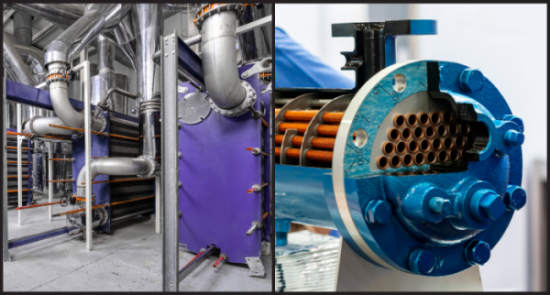
At O’Neal Manufacturing Services (OMS), we collaborate on new and existing products through our Value-Analysis/Value-Engineering (VA/VE) process. This allows us to validate the project requirement and manufacturing procedures before moving into production, saving development time, reducing costs, and delivering on schedule every time. Our skilled operations team works in coordination with engineering to address the specific requirements of each application, whether involving shell-and-tube or plate heat exchangers. This collaborative approach ensures that every detail is meticulously tailored to achieve optimal performance.
2. Selecting the Right Materials for Longevity and Efficiency
Material selection plays a pivotal role in heat exchanger fabrication, directly affecting both durability and operational performance. Stainless steel, carbon steel, and various specialty alloys are selected according to their corrosion resistance, thermal conductivity, and mechanical strength. Once materials are defined by the customer’s engineering specifications, precision fabrication becomes essential to achieving consistent, high-quality performance.
O’Neal Manufacturing Services delivers reliable, high-precision fabrication of heat exchanger components by leveraging advanced cutting, forming, and welding capabilities across its facilities. Working from customer-provided designs, our fabrication and quality teams ensure materials are processed accurately, meet regulatory requirements, and achieve consistent manufacturability. Through first article inspections and rigorous quality‑control procedures, OMS helps customers validate component performance and maintain long‑term durability in demanding industries such as power generation, oil and gas, and HVAC systems.
3. Precision Cutting and Forming for Complex Geometries
Leveraging fabrication technologies such as oxy cutting, plasma cutting, CNC milling, and drilling ensures tight tolerance and repeatability, especially for complex tube sheets, baffles, plates, and supporting frames. OMS offers advanced burning and forming capabilities, including plasma and oxy cutting, and CNC milling and drilling machining centers, allowing the creation of intricate shapes and large assemblies needed in industrial heat exchangers. Ensuring accuracy at this stage is crucial for proper fit-up and leak-free operation.
4. High-Quality Welding and Assembly Techniques
Welding quality directly impacts the structural integrity and performance of heat exchangers. Techniques such as TIG, MIG, laser welding, and robotic welding are used to join vital components. Certified welders and inspectors at each OMS location, along with ISO 9001:2015 and American Welding Society D1,1 certifications, ensure compliance with pressure rating requirements.
5. Surface Treatment and Finishing to Improve Durability
Surface treatments such as blasting, painting, or powder coating safeguard heat exchangers from corrosion and environmental damage. Finishing processes are chosen based on application needs, with options like epoxy coatings or high-temperature paints offering additional protection.
By implementing quality-controlled finishing processes, O’Neal Manufacturing Services can extend the lifespan of heat exchanger components, sustain efficiency, and ensure OEM compliance with industry standards for durability and performance.
6. Rigorous Testing and Quality Assurance
At OMS, our quality assurance programs are backed by recognized certifications, including ISO 9001:2015 and AWS D1.1. Each fabricated heat exchanger undergoes thorough testing, such as hydrostatic, pneumatic, and non-destructive examinations, to verify pressure integrity and leak-free performance. Dimensional inspections and material traceability further ensure every unit meets project specifications.
Customers trust O’Neal Manufacturing Services to provide vertically integrated, turnkey solutions that guarantee consistency and repeatability. We are committed to continuous improvement and consistently deliver high-quality products that support our customers’ success.
7. Streamlining Supply Chain and Delivery for Project Success
Effective supply chain management is vital for delivering heat exchanger components on schedule and within budget. With strategically placed facilities and backup production capacity, O’Neal Manufacturing Services can handle large projects, shorten lead times, and offer flexibility to meet evolving needs. This end-to-end approach ensures project timelines are met and operational risks are reduced.
For scalable manufacturing, material expertise, quality consistency, and supply chain reliability, OEMs rely on O’Neal Manufacturing Services to fulfill their most demanding heat exchanger production needs.